The Mechanics of Muzzle Flip and Technical Countermeasures
1. Introduction
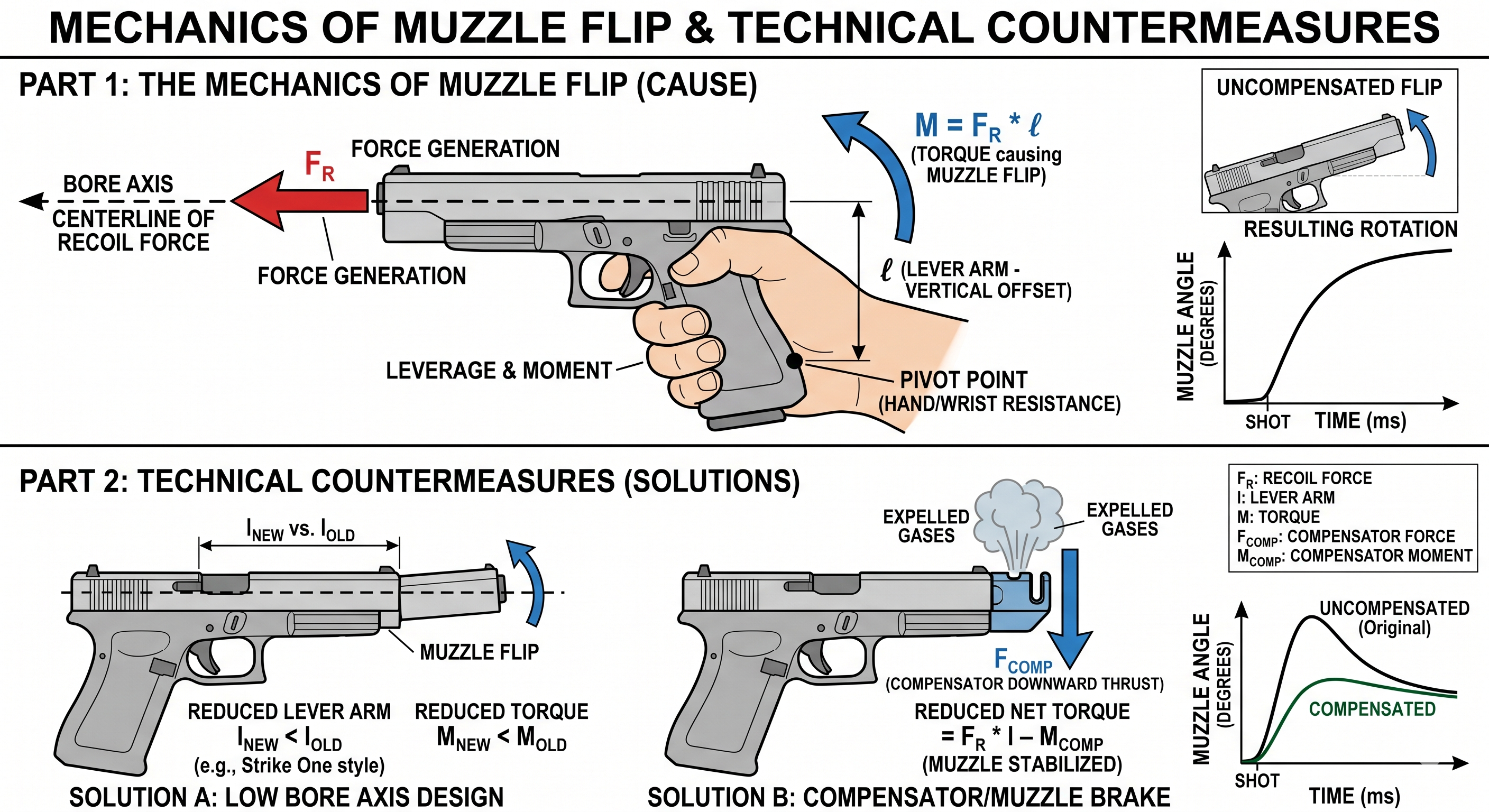
During the firing cycle, the recoil impulse acts—according to the principle of action and reaction—in direct extension of the barrel axis. In practical application, however, a firearm is rarely a mass-less point; rather, it is a complex mechanical system. "Muzzle flip" (or muzzle climb) is the result of a lever arm that exists between the barrel axis and the shooter's point of resistance (the shoulder stock in rifles, or the wrist/forearm in handguns).
2. Physical Cause: Torque
The recoil impulse $F_R$ acts along the barrel axis. However, the shooter's resistance $F_W$ is applied at a lower point (the grip or butt plate).
-
The Lever Arm: There is a vertical distance between the barrel axis and the center of the resistance, defined as the lever arm $l$.
-
Torque: The resulting torque $M$ is calculated by the equation:
$$M = F_R \cdot l$$This leverage effect causes the firearm to rotate around the wrist or shoulder point. The greater the offset $l$, the more pronounced the resulting muzzle movement. If $l = 0$ (linear alignment of the barrel axis and the shoulder/hand), the impulse would theoretically be transferred into the shooter's system purely as a linear recoil ("push") without any rotational moment.
3. Engineering Strategies to Reduce Muzzle Flip
To minimize muzzle flip, firearms engineers pursue three primary approaches:
A. Geometric Optimization (Lowering the Barrel Axis)
The most effective way to reduce torque is to shorten the lever arm $l$.
-
Examples:
-
Handguns: Designs such as the Arsenal Firearms Strike One or the Chiappa Rhino (the latter fires from the bottom chamber of the cylinder) feature an extremely low bore axis to bring it as close to the hand as possible.
-
Rifles: The AR-15 system places the buffer assembly in the stock to accommodate the platform's design, whereas Bullpup rifles (e.g., Steyr AUG) allow for a higher sighting plane while maintaining better control by positioning the action closer to the shooter's body.
-
B. Fluidic Countermeasures (Compensators/Muzzle Brakes)
When the torque cannot be further reduced through design alone, a counter-moment is generated.
-
Operating Principle: A compensator directs a portion of the high-pressure propellant gases upward. As these gases exit, they generate a downward thrust (recoil force), which neutralizes the torque generated by the primary recoil.
-
Examples:
-
IPSC Sport Firearms: Highly sophisticated multi-chamber compensators (ports) that nearly eliminate muzzle flash and climb.
-
Integral Ports: In some pistols (e.g., Glock 17C), ports are machined directly into the barrel and slide to utilize the "port effect" to keep the muzzle down.
-
C. Mass and Center of Gravity Redistribution
The inertia of the firearm plays a decisive role in resisting rotation.
-
Center of Gravity: A firearm with a muzzle-heavy weight distribution (e.g., through heavy-contour barrels or accessories) requires greater torque to initiate rotation. This increases "stability" against muzzle flip, though it comes at the cost of overall weight and handling agility.
4. Conclusion
Muzzle flip is not an unavoidable inevitability, but a calculable result of firearm geometry. While reducing the lever arm ($l$) is the most elegant solution because it addresses the problem at its kinematic root, muzzle compensators provide a powerful dynamic solution. In modern firearms development, the combination of a low bore axis and targeted gas redirection represents the benchmark for precision in rapid fire, especially in competitive shooting.
 Deutsch (Österreich)
  English (United Kingdom)