
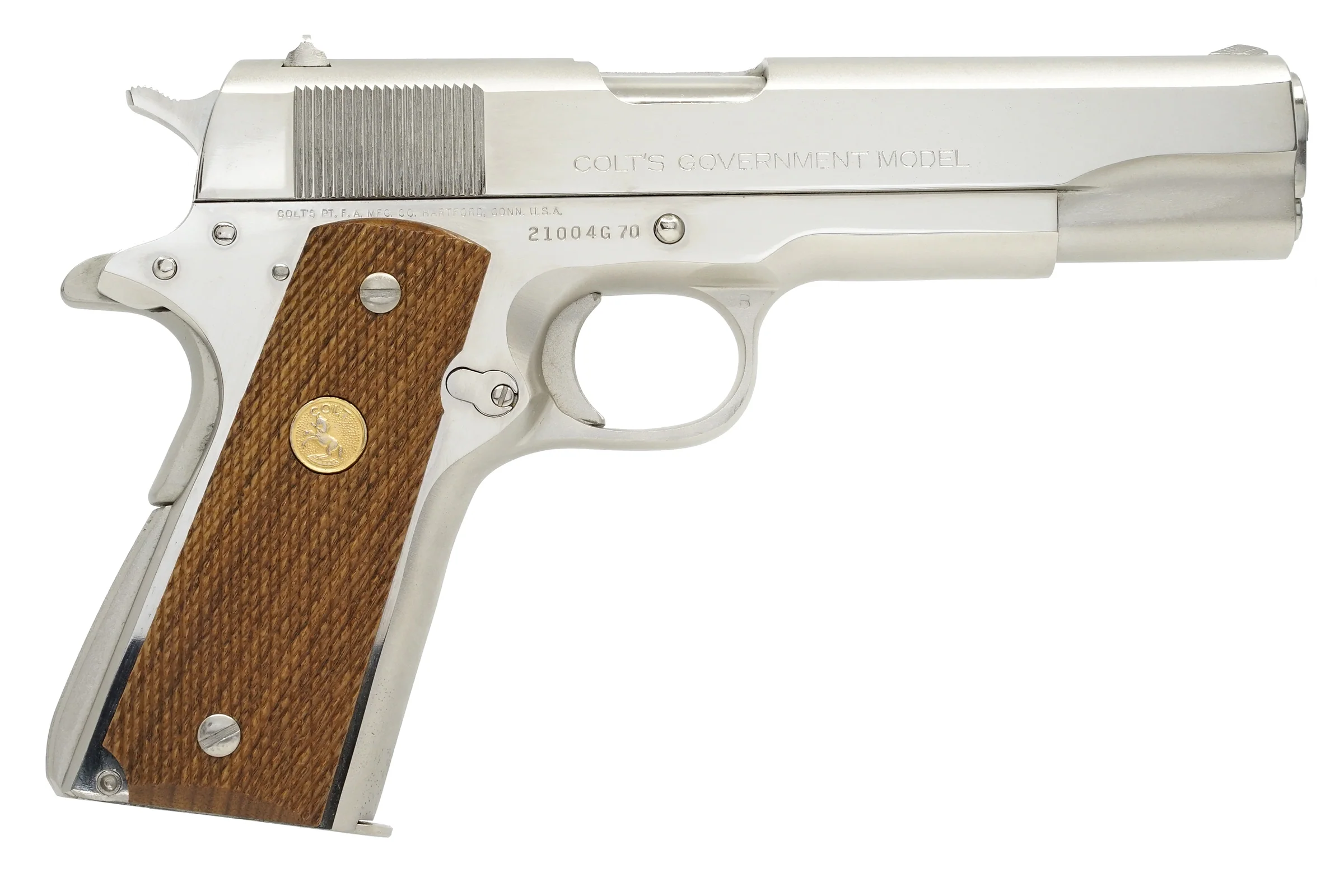
Colt .45 Government Series 70
The Colt .45 Government Series 70 is a famous and iconic pistol closely linked to the history of the US military and weapons development. Here is a structured presentation about the Colt .45 Government Series 70, covering the history, technology, usage and some interesting aspects of this pistol.
Presentation: Colt .45 Government Series 70
1. Introduction
The Colt .45 Government Series 70 is a semi-automatic pistol originally designed by John Browning in 1911. It is an evolution of the original model that formed the basis for the M1911 pistol. The Series 70 is one of the most famous variants of this model and is still valued by many shooters today, both for duty and for private use.
2. The Development of the M1911: A Detailed Overview
The history of the Colt M1911, as you've outlined, accurately captures the essential milestones of this iconic pistol. Its development was a direct response to the military necessities of the early 20th century and a masterpiece by the legendary firearms designer John Moses Browning.
The Origins: The Search for More Stopping Power (ca. 1904-1906)
As correctly stated, the insufficient performance of the .38 Long Colt during the Philippine-American War was the catalyst for the search for a new service pistol. The U.S. Army concluded that a caliber of at least .45 was necessary to achieve the required stopping power in close-quarters combat. This led to a formal request for a new, semi-automatic pistol.
John Moses Browning, who already had extensive experience developing self-loading pistols for Colt and Fabrique Nationale (FN)—including models like the Colt M1900 and M1902—took on this challenge. He designed a robust locking mechanism, known today as the Browning tilting-barrel system, and simultaneously developed a powerful new cartridge to match: the .45 ACP (Automatic Colt Pistol). The first model to use this cartridge was the Colt Model 1905.
The Trial Phase and Birth of the M1911 (1906-1911)
In the demanding, multi-year trials conducted by the U.S. Army, Browning's design prevailed over numerous competitors, ultimately winning against the model from the Savage Arms Company. The decisive test took place in late 1910, where a single Colt pistol fired a legendary 6,000 rounds without a single malfunction. The weapon was periodically dipped in water to cool it down, proving a level of reliability previously unheard of.
Following this impressive performance and some final ergonomic adjustments requested by the Army, the pistol was officially adopted on March 29, 1911, as the "U.S. Pistol, Calibre .45 of 1911"—or M1911 for short.
The Modernization to the M1911A1 (1923-1926)
Based on experiences from World War I, it was decided to make some minor changes to optimize handling. This led to the introduction of the M1911A1 model in 1926. The key differences from the original M1911 were:
-
Arched mainspring housing: Provided a better grip in the hand.
-
Shorter trigger: Made it easier for shooters with smaller hands to operate.
-
Extended "beavertail" grip safety: Prevents the shooter's hand from being pinched by the hammer ("hammer bite").
-
Relief cuts on the frame behind the trigger: Allowed for easier access to the trigger.
-
Wider front sight and rounded rear sight: For faster target acquisition.
In this only slightly modified form, the weapon remained the standard-issue service pistol of the U.S. Armed Forces for the next six decades.
Service Life, Variants, and Replacement (1911-1985)
The M1911 and M1911A1 served in both World Wars, the Korean War, and the Vietnam War, proving themselves to be extremely robust, reliable, and powerful weapons.
-
British Variant: As mentioned, Great Britain ordered M1911 pistols in the .455 Webley Automatic caliber during World War I. These were primarily issued to pilots of the Royal Flying Corps and to the Royal Navy, as a semi-automatic pistol was more practical than a revolver in the confines of a cockpit or during naval operations.
-
Replacement: It was not until 1985 that the M1911A1 was officially replaced by the Beretta 92FS (military designation M9) in the NATO standard caliber of 9x19mm. The reasons for the change included the Beretta's higher magazine capacity (15 vs. 7/8 rounds) and the standardization of ammunition within NATO.
The Legacy: A Legend Lives On
Despite its official decommissioning, the M1911 platform continued to be used in modernized forms by many U.S. special operations units (e.g., the Marine Corps Forces Special Operations Command) for decades. To this day, the M1911 design remains one of the most popular and most copied firearm platforms in the world. Numerous manufacturers offer variants for sport shooters, hunters, and the civilian market, underscoring the timelessness and genius of John Browning's design.
The Series 70
- 1970: Colt began producing the Colt .45 Government Series 70, an evolution of the original M1911.
- Series 70 Feature: The Series 70 featured improved manufacturing technology and a revised trigger mechanism.
- Difference from the Series 80: The Series 70 omitted the additional safety feature (access block) of the later Series 80, which is intended to protect the weapon from accidental firing.
Military and civilian use
- The M1911 and its variants were used in both military and civilian applications for decades. Even after 1911, versions of the pistol remained in use, both by military and law enforcement agencies.
3. Technical characteristics of the Colt .45 Government Series 70
- Caliber: .45 ACP (Automatic Colt Pistol)
- Magazine capacity: 7+1 rounds
- Barrel length: 5 inches (127 mm)
- Total length: 8.5 inches (216 mm)
- Weight: About 1.1kg (without magazine)
- Fire mechanism: Semi-automatic (self-loading)
- Construction: Steel carriage and aluminum frame (modern variants sometimes also have a steel frame)
- Trigger: Single Action - the trigger must be cocked manually before each shot.
- Safety features:
- Thumb safety (Manual Safety)
- Grip safety
Specific features of the Series 70
- Pulling the Springs: The original M1911 design featured a spring and trigger mechanism that was fine-tuned in the Series 70 to improve firing performance.
- No additional safety features: In contrast to the Series 80, the Series 70 did not have an additional "firing pin safety", which made it popular with many shooters for its more precise and direct trigger action.
4. Using the Colt .45 Government Series 70
Military use
- US Army: The M1911 pistol (including later versions such as the Series 70) saw service with the US Army for decades, particularly during World Wars I and II, the Korean War and the Vietnam War.
- Use in conflict: During their service, they were used by soldiers and militaries worldwide to increase effectiveness and safety in combat.
Civilian use
- Sports and Leisure: Today the Colt .45 Government Series 70 is a very popular pistol for sport shooters, especially in disciplines such as IPSC (International Practical Shooting Confederation) and rapid fire shooting.
- Collectible: Because of its historical significance and legendary history, the Colt .45 is also prized by gun enthusiasts and collectors.
Police and law enforcement
- Law Enforcement Use: Many police departments in the United States and worldwide have used the M1911 in various variants, including the Series 70.
5. Significance of the Colt .45 Government Series 70 in firearms history
- Reliability: The M1911 pistol, including the Series 70, has earned a reputation for its extremely high reliability and shooting accuracy.
- Influence on weapon technology: John Browning's design of the M1911 was groundbreaking and significantly influenced the development of future pistol models that adopted similar mechanisms and safety features.
- Popularity: The Series 70 is considered in many gun circles to be one of the best semi-automatic pistols for precision shooting.
6. Images of the Colt .45 Government Series 70
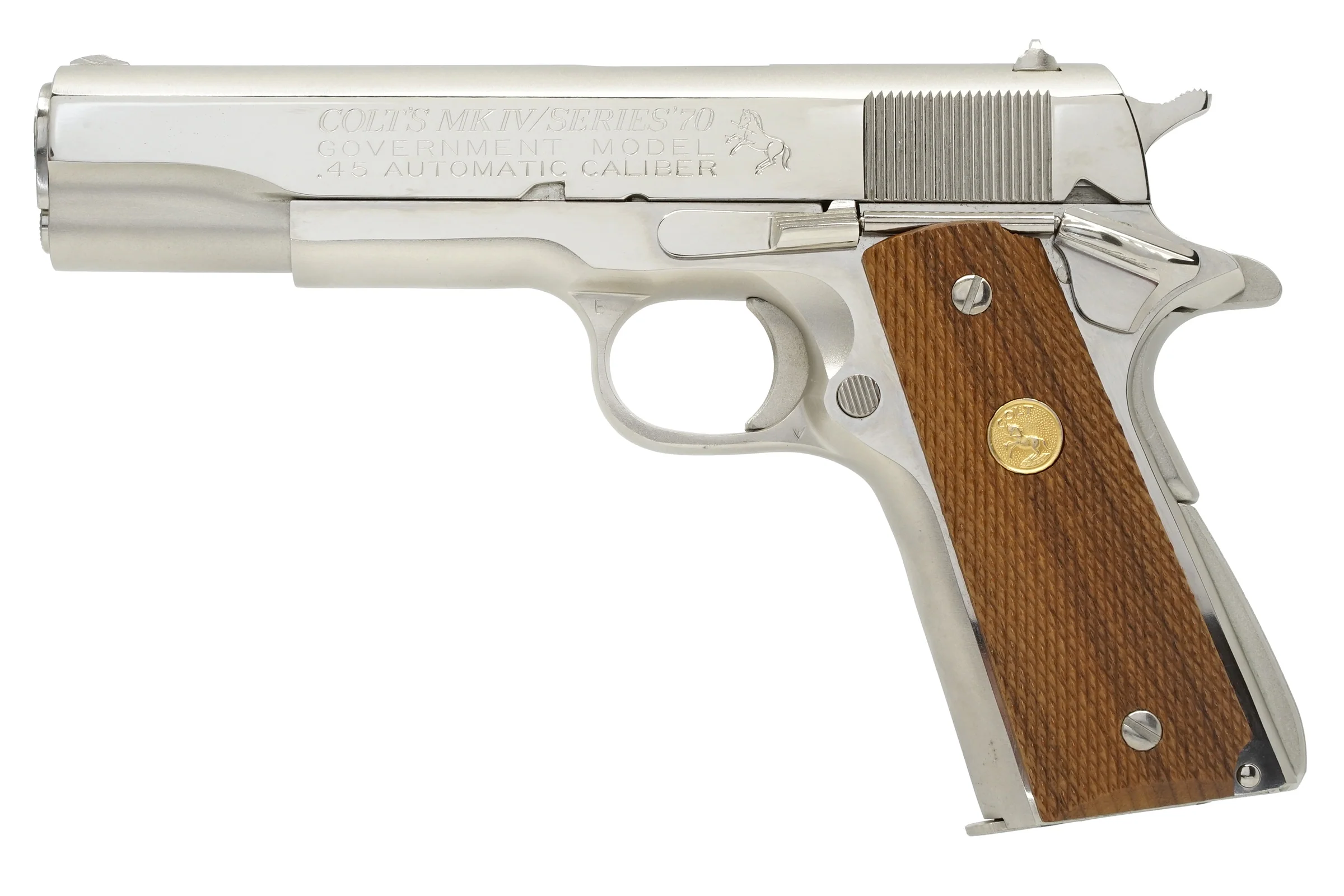
Image 1: A standard model Colt .45 Government Series 70
Image 2: Detailed shot of the Colt .45 Series 70 with visible slide and grip
7. Conclusion
The Colt .45 Government Series 70 is a remarkable piece of firearms history. Its robust construction, precise manufacturing and close connection to US military history make it one of the most legendary pistols in the world. Although no longer in use in the United States military services, the Series 70 remains a popular choice in civilian and sporting circles due to its performance and history.
useful movies:
| Nr. | Link | Detail |
| 1 | Colt 1911 disassemble | Disassemble and assemble of a Colt 1911 |
 Deutsch (Österreich)
  English (United Kingdom)